Tarot
The Hierophant
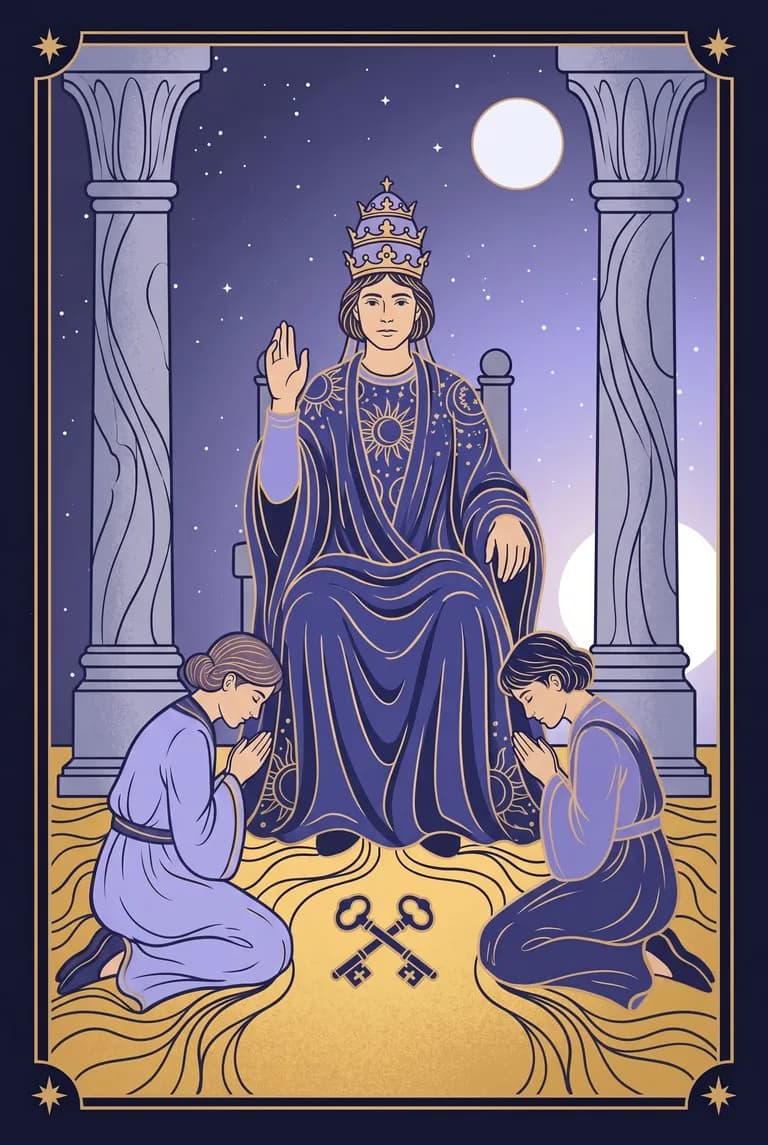
Upright
Upright, the Hierophant is read in the tarot tradition as continuity — inherited knowledge, teachers and lineages, the beliefs a community holds in common. Rider-Waite-Smith frames him between pillars, keys crossed at his feet, a keeper of accepted forms. Held as a mirror, the card offers a theme rather than a rule: where guidance, a mentor, or a tested framework might steady you, and where an inherited script deserves a second look. The two figures below read as room for your own reading, not a call to obey blindly. Tradition can be a foothold or a cage depending on how you hold it. Which parts to keep stays yours to sort.
Reversed
The upright Hierophant speaks for shared belief, institutions, and the well-worn path. Reversed, that voice loosens — you may feel out of step with a convention, drawn toward your own reading of things rather than the received one. Read as a mirror for the moment, the card traditionally marks a season of sorting inherited rules from chosen ones. The theme to check in practice is fit: which traditions still hold meaning for you, and which you keep only out of habit. Breaking form is not rebellion for its own sake here; it is discernment. You get to belong on your own terms, keeping what rings true and setting the rest gently down.
Draw your card of the day
One card a day, drawn with a cryptographic shuffle and fixed before it is read. Free with an account.
Nearby cards
Cards are prompts for reflection. They describe themes, not events.
For self-reflection and entertainment — not a prediction of fate and not professional advice.