Tarot
Seven of Cups
Upright
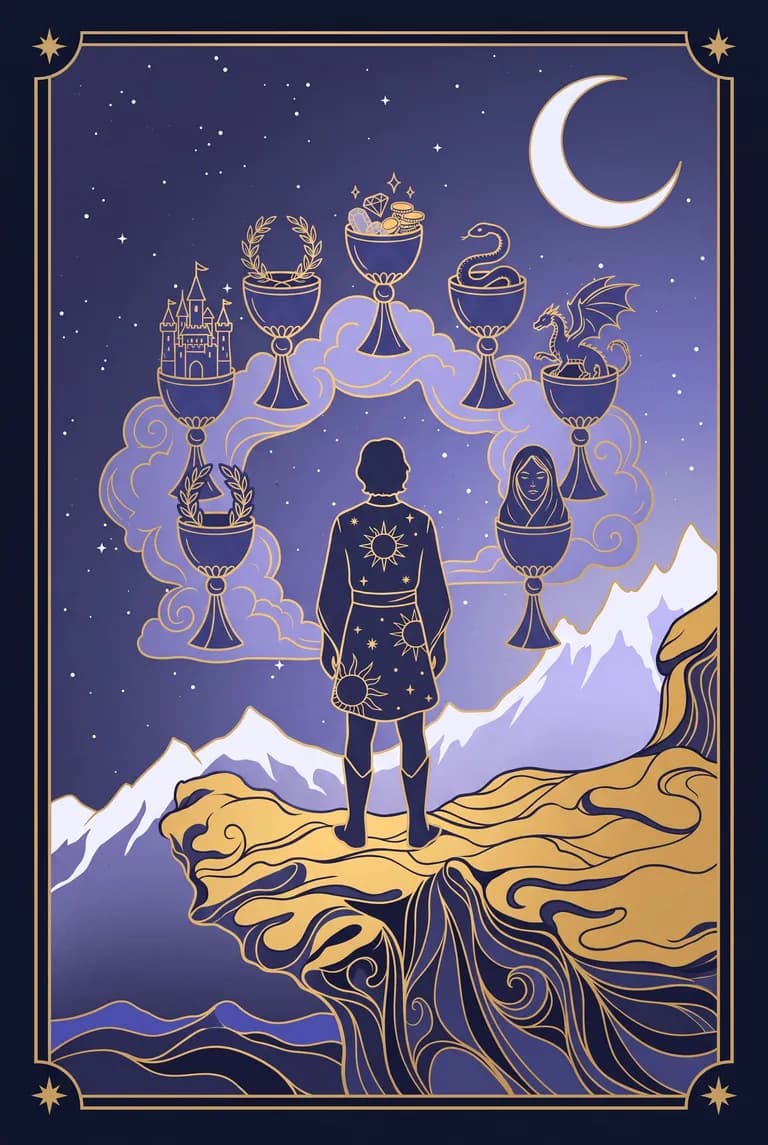
A silhouette gazes at seven cups rising in cloud, each brimming with something different — a face, jewels, a wreath, a shrouded figure, a castle. Readers hold the card as a mirror for a crowded inner moment, not a forecast: many possibilities glittering at once, some solid, some pure daydream. Upright, the theme is imagination and the discernment it calls for — the pleasure of options and the fog that too many can bring. Offered as reflection, it points to something worth testing in practice: which cup you keep circling, and whether it holds substance or shimmer. The tradition spreads the choices out. Which one you lift toward the light stays yours.
Reversed
Reversed, the Seven of Cups is traditionally read as the fog lifting — the moment scattered fantasies resolve into something you can actually choose. Rider-Waite-Smith floats seven cups before a shadowed figure, each holding a different lure or specter; turned over, the illusions lose their pull and one real option steps forward. As a mirror for the moment, the card surfaces a theme rather than a command: where a season of too many possibilities, or wishful drifting, might be ready to give way to a single grounded step. The reversal reads as clarity, not a scolding for having dreamed. Imagination did its work. Which cup you finally lift, and when, remains entirely your call.
Draw your card of the day
One card a day, drawn with a cryptographic shuffle and fixed before it is read. Free with an account.
Nearby cards
Cards are prompts for reflection. They describe themes, not events.
For self-reflection and entertainment — not a prediction of fate and not professional advice.